Pages

Showing posts with label Leonardo da Vinci's Paintings. Show all posts

Friday, August 10, 2012

How to Draw Mona Lisa Using Fonts and Texts

How to Draw Mona Lisa Using Fonts and Texts
Mona Lisa is the world most famous painting made by Leonardo da Vinci. He started painting the Mona Lisa in 1503 or 1504 in Florence, Italy.

This is another fun way to use text in drawing. Watch the video.


 How to Draw using Fonts and Text - (The Portrait of a Young Venetian Woman)
(Ex. The Portrait of a Young Venetian Woman by Albrecht Dürer)
I used Arial bold as font in typing. This was made just for fun.

Wednesday, February 15, 2012

Portrait of Ginevra de Benci - Painting of Leonardo da Vinci

Portrait of Ginevra de Benci - Painting of Leonardo da Vinci
Portrait of Ginevra de Benci - 1478-1480
Painting of Leonardo da Vinci

Friday, January 20, 2012

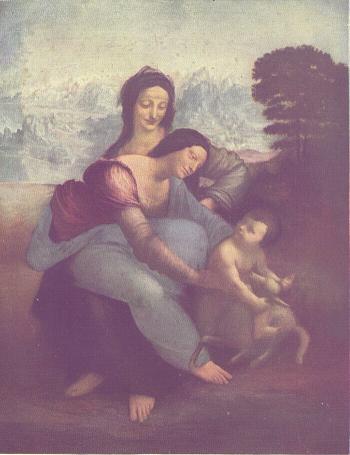
Madonna, Infant Christ and St Anne - Leonardo Da Vinci's Painting

Madonna, Infant Christ and St Anne-Leonardo Da Vinci's Painting

MADONNA, INFANT CHRIST, AND ST. ANNE
by Leonardo Da Vinci
In the Louvre. No. 1508. 5 ft. 7 in. h. by 4 ft. 3 in. w. (1.70 x 1.29)
Painted between 1509 and 1516 with the help of assistants.

Portrait of Lucrezia Crivelli - Painting of Leonardo Da Vinci

Portrait of Lucrezia Crivelli - Painting of Leonardo Da Vinci

PORTRAIT (PRESUMED) OF LUCREZIA CRIVELLI
In the Louvre. No. 1600 [483]. 2 ft by I ft 5 ins. (0.62 x 0.44)
This picture, although officially attributed to Leonardo, is probably not by him, and almost certainly does not represent Lucrezia Crivelli. It was once known as a "Portrait of a Lady" and is still occasionally miscalled "La Belle Féronnière."

Wednesday, January 18, 2012

The Head of Christ - Painting of Leonardo Da Vinci

The Head of Christ - Painting of Leonardo da Vinci
THE HEAD OF CHRIST
by Leonardo Da Vinci
In the Brera Gallery, Milan. No. 280. 1 ft. 0-1/2 ins. by 1 ft. 4 ins. (0.32 x 0.40)

Monday, January 16, 2012

The Last Supper - Painting by Leonardo da Vinci

The Last Supper Painting by Leonardo da Vinci

Between 1496 and 1498 Leonardo painted his _chef d'oeuvre_, the "Last Supper," for the end wall of the Refectory of the Dominican Convent of S. Maria delle Grazie at Milan. It was originally executed in tempera on a badly prepared stucco ground and began to deteriorate a very few years after its completion. As early as 1556 it was half ruined. In 1652 the monks cut away a part of the fresco including the feet of the Christ to make a doorway. In 1726 one Michelangelo Belotti, an obscure Milanese painter, received £300 for the worthless labour he bestowed on restoring it. He seems to have employed some astringent restorative which revived the colours temporarily, and then left them in deeper eclipse than before. In 1770 the fresco was again restored by Mazza. In 1796 Napoleon's cavalry, contrary to his express orders, turned the refectory into a stable, and pelted the heads of the figures with dirt. Subsequently the refectory was used to store hay, and at one time or another it has been flooded. In 1820 the fresco was again restored, and in 1854 this restoration was effaced. In October 1908 Professor Cavenaghi completed the delicate task of again restoring it, and has, in the opinion of experts, now preserved it from further injury. In addition, the devices of Ludovico and his Duchess and a considerable amount of floral decoration by Leonardo himself have been brought to light.

Reference:

LEONARDO DA VINCI

By MAURICE W. BROCKWELL

The Virgin of the Rocks - Painting by Ambrogio da Predis with Leonardo da Vinci

The Virgin of the Rocks - Painting by Leonardo da Vinci

THE VIRGIN OF THE ROCKS
In the National Gallery. No. 1093. 6 ft. ½ in. h. by 3 ft 9 ½ in. w. (1.83 x 1.15)
This picture was painted in Milan about 1495 by Ambrogio da Predis under the supervision and guidance of Leonardo da Vinci, the essential features of the composition being borrowed from the earlier "Vierge aux Rochers," now in the Louvre.

The "Virgin of the Rocks", now in the National Gallery, corresponds exactly with a painting by Leonardo which was described by Lomazzo about 1584 as being in the Chapel of the Conception in the Church of St. Francesco at Milan. This picture, the only _oeuvre_ in this gallery with which Leonardo's name can be connected, was brought to England in 1777 by Gavin Hamilton, and sold by him to the Marquess of Lansdowne, who subsequently exchanged it for another picture in the Collection of the Earl of Suffolk at Charlton Park, Wiltshire, from whom it was eventually purchased by the National Gallery for £9000. Signor Emilio Motta, some fifteen years ago, unearthed in the State Archives of Milan a letter or memorial from Giovanni Ambrogio da Predis and Leonardo da Vinci to the Duke of Milan, praying him to intervene in a dispute, which had arisen between the petitioners and the Brotherhood of the Conception, with regard to the valuation of certain works of art furnished for the chapel of the Brotherhood in the church of St. Francesco. The only logical deduction which can be drawn from documentary evidence is that the "Vierge aux Rochers" in the Louvre is the picture, painted about 1482, which between 1491 and 1494 gave rise to the dispute, and that, when it was ultimately sold by the artists for the full price asked to some unknown buyer, the National Gallery version was executed for a smaller price mainly by Ambrogio da Predisunder the supervision, and with the help, of Leonardo to be placed in the Chapel of the Conception.

Reference:

LEONARDO DA VINCI

By MAURICE W. BROCKWELL

Portrait of Mona Lisa - Painting by Leonardo da Vinci

Portrait of Mona Lisa - Painting by Leonardo da Vinci
MONA LISA. In the Louvre. No. 1601. 2 ft 6 ½ ins. By 1 ft. 9 ins.(0.77 x 0.53)


Early in 1503 Leonardo da Vinci was back again in Florence, and set to work in earnest on the "Portrait of Mona Lisa", now in the Louvre (No. 1601). Lisa di Anton Maria di Noldo Gherardini was the daughter of Antonio Gherardini. In 1495 she married Francesco di Bartolommeo de Zenobi del Giocondo. It is from the surname of her husband that she derives the name of "La Joconde," by which her portrait is officially known in the Louvre. Vasari is probably inaccurate in saying that Leonardo "loitered over it for four years, and finally left it unfinished." He may have begun it in the spring of 1501 and, probably owing to having taken service under Cesare Borgia in the following year, put it on one side, ultimately completing it after working on the "Battle of Anghiari" in 1504. Vasari's eulogy of this portrait may with advantage be quoted: "Whoever shall desire to see how far art can imitate nature may do so to perfection in this head, wherein every peculiarity that could be depicted by the utmost subtlety of the pencil has been faithfully reproduced. The eyes have the lustrous brightness and moisture which is seen in life, and around them are those pale, red, and slightly livid circles, also proper to nature. The nose, with its beautiful and delicately roseate nostrils, might be easily believed to be alive; the mouth, admirable in its outline, has the lips uniting the rose-tints of their colour with those of the face, in the utmost perfection, and the carnation of the cheek does not appear to be painted, but truly flesh and blood. He who looks earnestly at the pit of the throat cannot but believe that he sees the beating of the pulses. Mona Lisa was exceedingly beautiful, and while Leonardo was painting her portrait, he took the precaution of keeping some one constantly near her to sing or play on instruments, or to jest and otherwise amuse her."

Leonardo painted this picture in the full maturity of his talent, and, although it is now little more than a monochrome owing to the free and merciless restoration to which it has been at times subjected, it must have created a wonderful impression on those who saw it in the early years of the sixteenth century. It is difficult for the unpractised eye to-day to form any idea of its original beauty. Leonardo has here painted this worldly-minded woman—her portrait is much more famous than she herself ever was—with a marvellous charm and suavity, a finesse of expression never reached before and hardly ever equalled since. Contrast the head of the Christ at Milan, Leonardo's conception of divinity expressed in perfect humanity, with the subtle and sphinx-like smile of this languorous creature.

The landscape background, against which Mona Lisa is posed, recalls the severe, rather than exuberant, landscape and the dim vistas of mountain ranges seen in the neighbourhood of his own birthplace. The portrait was bought during the reign of Francis I. for a sum which is to-day equal to about £1800. Leonardo, by the way, does not seem to have been really affected by any individual affection for any woman, and, like Michelangelo and Raphael, never married.

In January 4, 1504, Leonardo was one of the members of the Committee of Artists summoned to advise the Signoria as to the most suitable site for the erection of Michelangelo's statue of "David," which had recently been completed.

Reference:

LEONARDO DA VINCI


By MAURICE W. BROCKWELL

Sunday, January 15, 2012

Leonardo da Vinci's Painting - Annunciation In the Uffizi Gallery

Leonardo da Vinci's Painting - Annunciation In the Uffizi Gallery

Annunciation In the Uffizi Gallery, Florence 
No. 1288. 3 ft 3 ins. By 6 ft 11 ins. (0.99 x 2.18)] Although this panel is included in the Uffizi Catalogue as being by Leonardo, it is in all probability by his master, Verrocchio.]
Related Posts Plugin for WordPress, Blogger...